Componentix logo componentix | portfolio | request quote | blog

Componentix blog

Here we write some random thoughts and articles about software development: Java, Grails, iPhone and more.
Subscribe in a reader
Follow Componentix on Twitter

File uploads using Node.js: once again

I’ve already wrote an article about file uploads in Node.js before. However Node.js is in rapid development and so many things have changed since then.

So, I decided to do an updated version, which accommodates for such changes:

  • events module was removed
  • posix module was replaced by fs
  • various changes into HTTP request/response API
  • multipart module refactored into separate project
  • convenient fs.createWriteStream instead of low-level API

See the code snippet under the cut, or on github. Special thanks goes to Felix Geisendörfer for some useful suggestions.

Please note that you’ll need to install multipart module for the code to work.

To make it clear, Node.js version used was v. 0.1.91.

UPD: Fixed stream.onData handler. It was writing corrupted data (UTF-8 character were translated) because of binary mode not being used. Thanks to Ron Ward for suggesting solution.

Read more...

File uploads using Node.js: now for real

Introduction

Node.js is a very interesting server-side Javascript application framework. It is based on Google’s V8 Javascript engine and implements evented I/O, so it is blazing fast. It looks very promising for certain types of applications, mostly those that require long-running connections. This includes streaming big files, keeping persistent connections used for realtime communication (chat, games), applications using third-party web services (with long call times), etc.

There is good enough API reference available for Node.js, however it is not trivial to start development as event-based approach is quite unusual compared to commonly used thread-based networking. There are some useful blog posts with code samples available in Debuggable blog, e.g. Streaming file uploads with node.js.

However the given examples have problem — they are too far from real world problems. Take file upload as example — the code sample provided has absolutely no info on how to save the uploaded file. It is assumed that it would be trivial for the reader to figure out, however it’s not when we have to follow evented I/O approach.

In this post I’ll show example of how to save the uploaded files with Node.js. For the impatient — just grab source from github repository.

UPD: The code here is obsolete, see new article about file uploads in new Node.js version.

Read more...

Twitter and Google Maps mashup in 20 minutes with Grails

Introduction

For many developers Java is often a synonym for totally non-sexy enterprise applications development. It is associated with numerous XML configuration files, boilerplate code, etc. So they instead use dynamic languages like Ruby, Python, PHP to develop their projects, especially when these are own simple utilities, mash-ups, etc.

However the Java field has changed much in the recent few years. There are multiple frameworks which relieve developer from “enterprise” burden. Grails is probably one of the best. It is based on Groovy, which is a dynamic language running on Java platform designed specially for Java programmers. It uses well known robust and efficient Java libraries to do all the heavy lifting (Spring, Hibernate, etc.). There is also a plugin system and plugins exist for almost every widely used Java library.

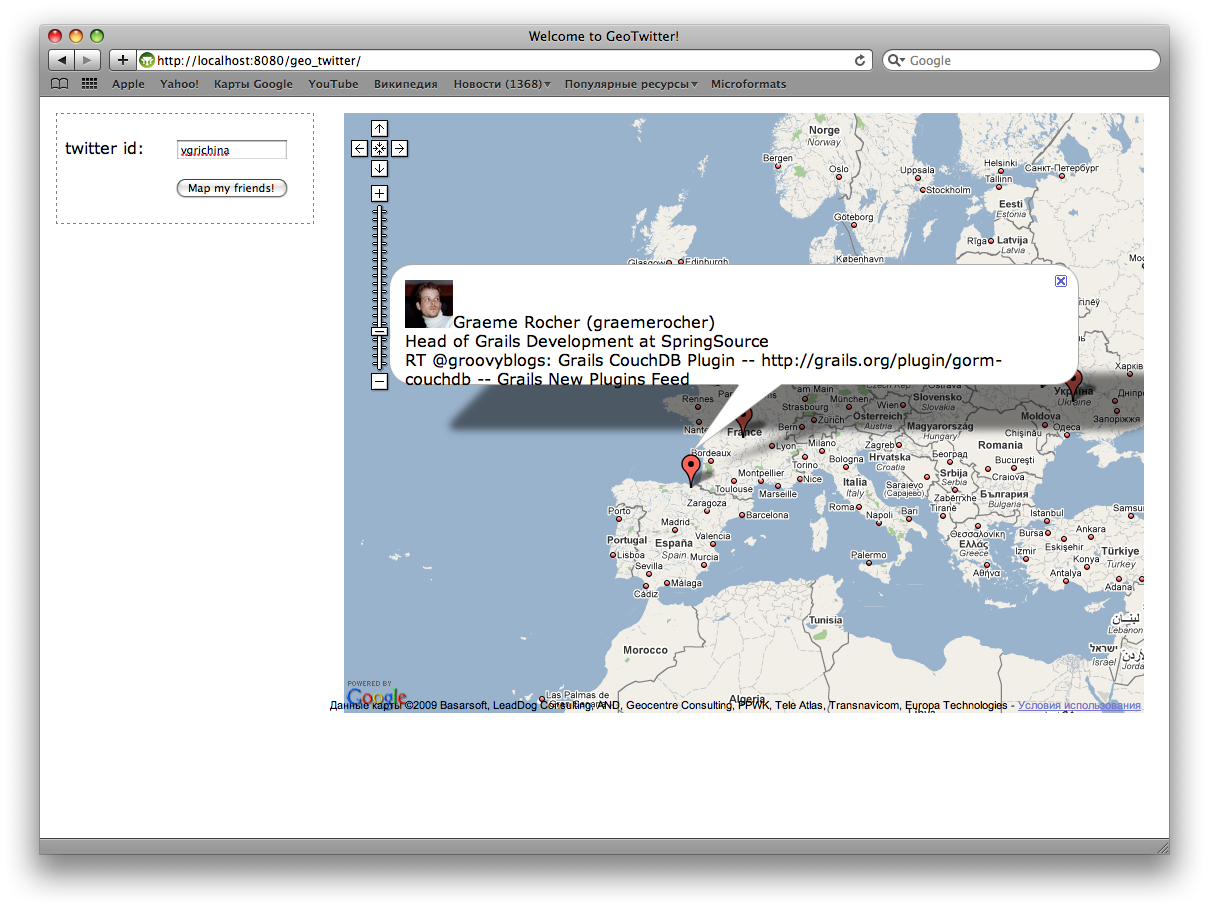
In this article we’ll show how to make a mash-up of Twitter and Google Maps in around 20 minutes. The end result will look similar to this:

Read more...
Following e-mail is only for robots (never send anything to it, or you would be blacklisted): botsonly@componentix.com